Soham Chatterjee | All Rights Reserved

I am Soham Chatterjee, a passionate developer skilled in:
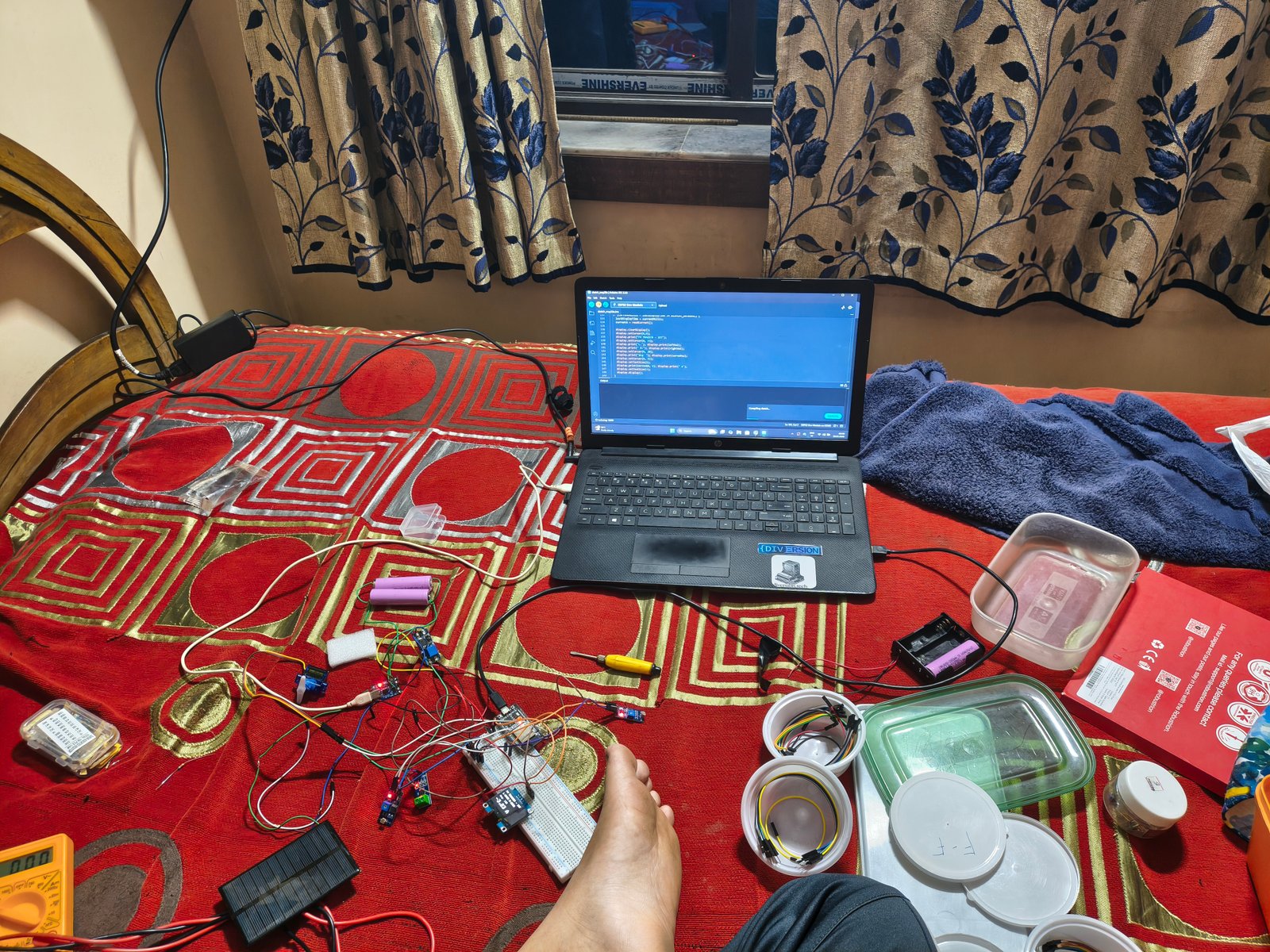
As urbanization and soaring temperatures put an unprecedented strain on Kolkata’s electrical grid, traditional thermal power plants are pushed to their limits to meet peak demand—especially during high-cooling afternoon hours. Our latest IoT project offers an intelligent, scalable intervention: an automated Solar Tracker tied directly to a predictive machine learning framework.
### The Technology Behind the Tracker
The prototype utilizes a dual-sensor Light Dependent Resistor (LDR) array mapped to an ESP32 microcontroller and an ultra-precise servo drive mechanism. By continuously reading differential light values, the system dynamically realigns the solar panel to capture maximum orthogonal irradiance throughout the day. To ensure stable deployment and high presentation accuracy, the device utilizes a built-in auto-calibration routine that completely filters ambient analog noise.
### Data Science Integration & Grid Scaling
Beyond simple physical tracking, the system integrates an intelligent prediction backend. By piping live generation data into a Linear Regression model trained on Kolkata's historical energy demand, we can mathematically forecast daily renewable yields.
When scaled from a single 5W prototype to a commercial-scale array (utilizing a 100,000-unit scale multiplier), the system demonstrates an immediate, visible reduction in the city’s dependency on traditional coal and gas thermal generation. The data is live-streamed to a cloud-based Blynk dashboard and systematically logged into structured Excel sheets for real-time grid balancing.
### Real-World Impact: Mapping to UN SDGs
Our smart grid framework actively champions three United Nations Sustainable Development Goals:
* **SDG 7 (Affordable and Clean Energy):** Maximizes photovoltaic efficiency through automated axis optimization.
* **SDG 9 (Industry, Innovation, and Infrastructure):** Bridges physical IoT hardware with predictive data analytics for robust, responsive smart-grid infrastructure.
* **SDG 13 (Climate Action):** Directly lowers carbon emissions by dynamically shrinking the remaining thermal power required during peak load periods.

Hi, I’m Soham Chatterjee — a passionate Computer Science and Engineering student with a strong interest in web development, artificial intelligence, and problem-solving. I enjoy building dynamic and efficient applications, exploring new technologies, and applying my knowledge to real-world projects. Beyond coding, I’m curious about design, innovation, and continuous learning, always striving to grow both personally and professionally.
Soham Chatterjee | All Rights Reserved